
“Good care is not something you achieve once and for all, it is something that must be promoted politically and socially.” Says Tine Rostgaard, Professor at Roskilde University (Denmark).
Tine Rostgaard, Professor in the Department of Social and Business Sciences at the University of Roskilde (Denmark) speaks at Zaintzen Zain - Who Cares conference
Tine Rostgaard, Professor in the Department of Social and Business Sciences at the University of Roskilde (Denmark), is widely recognised as one of the leading scholars in social welfare, care policies, and social justice. Her speech at “Zaintzen Zain – Who cares” conference in Bilbao offered a framework for understanding care systems as institutions of social justice.
During her talk, “The care system and its political implementation from a social justice perspective”, Rostgaard explained what social justice in care means and why it must be implement through political and public policies. Taking the Nordic welfare model as an example, she highlightedits ambitions and contradictions, arguing that no care system is ever permanently just. Even advanced models require continuous political struggle to defend equality, dignity, and solidarity.
Care for Older People as a Question of Social Justice
Care for the elder reflects fundamental principles of social justice; care systems express societal values about who deserves support, how risks are shared, and whose lives are considered dignified. The Nordic countries are often presented as exemplary cases in international debates, seen as ambitious welfare states, eventhough their challenges show how social justice in care can erode when not actively defended.
Care is not something societies “have forever.” Political priorities change, public budgets shift, and resources are reallocated, as shows the current geopolitical context. These choices directly affect care systems and reveal how fragile social justice can be when it competes with other political priorities.
The Nordic welfare model is based on universalism: access to care is grounded in citizenship rather then prior contributions. This model is rooted in the belief in equality across social classes and across age groups.
Equality is not only about access but also about quality. To ensure effecitve care, care services must be of sufficiently high quality to be attractive to everyone, not only to those who cannot afford alternatives. No poor services for poor people, but the same services for all. Care is a public responsibility rather than a family obligation. Care work is recognised as skilled labour, requiring regulation, training, and strong labour institutions. Public responsibility ensures equality of access, affordability, dignified care for patients, and decent working conditions for care workers. Families remain important sources of emotional and social support, but they are not expected to carry the full burden of care (defamilization).
Three dimensions to analyze social justice in care
Rostgaard’s argued that care systems are social justice systems distributing fundamental social resources. She identified three key dimensions through which social justice in care must be analysed:
- Redistribution: who receives care, how much time is available for care, and how financial resources are allocated.
- Recognition: what types of care are valued and whose work is acknowledged and respected.
- Representation: whose voices count in decision making processes, including care recipients, families, and care workers themselves.
Political choices determine who carries the burden of care and who benefits from protection.
Currently and despite strong welfare traditions, Nordic countries face a care crisis driven by demographic ageing, by labour shortages in care sectors, and increasing pressure on public budgets.
One indicator of this crisis is what Rostgaard referred to as “thin care”: resources become scarce, care services are reduced, standardised, and less responsive to individual needs. This will mean that some people receive care while others do not, producing new inequalities. Thin care also leads to gendered transfers of time : when formal services are reduced, families are expected to compensate, and this burden falls on women. At the same time, care work risks becoming low-status and under-recognised labour, undermining at the same time the sector’s attractiveness. Standardisation undermines person-centred care and fails to address diverse needs. In this way, the crisis directly affects both care recipients and care workers.
One of the most critical insights of Rostgaard’s analysis was the concept of silent stratification of citizenship. While Nordic systems formally uphold equality of access, changes in implementation gradually transform universalism in practice.
Universal public systems are increasingly becoming basic services used mostly by people who cannot afford alternatives, while others rely on private solutions. This shift often occurs quietly through amministrative changes to eligibility and rules rather in an open political debate, eroding equality.
During crises, as we saw the COVID-19 pandemic, some needs and categories are prioritised over others, and certain groups become more vulnerable. In long term care decision makers may implicitly raise thresholds for accessing services, effectively excluding individuals without openly acknowledging it.
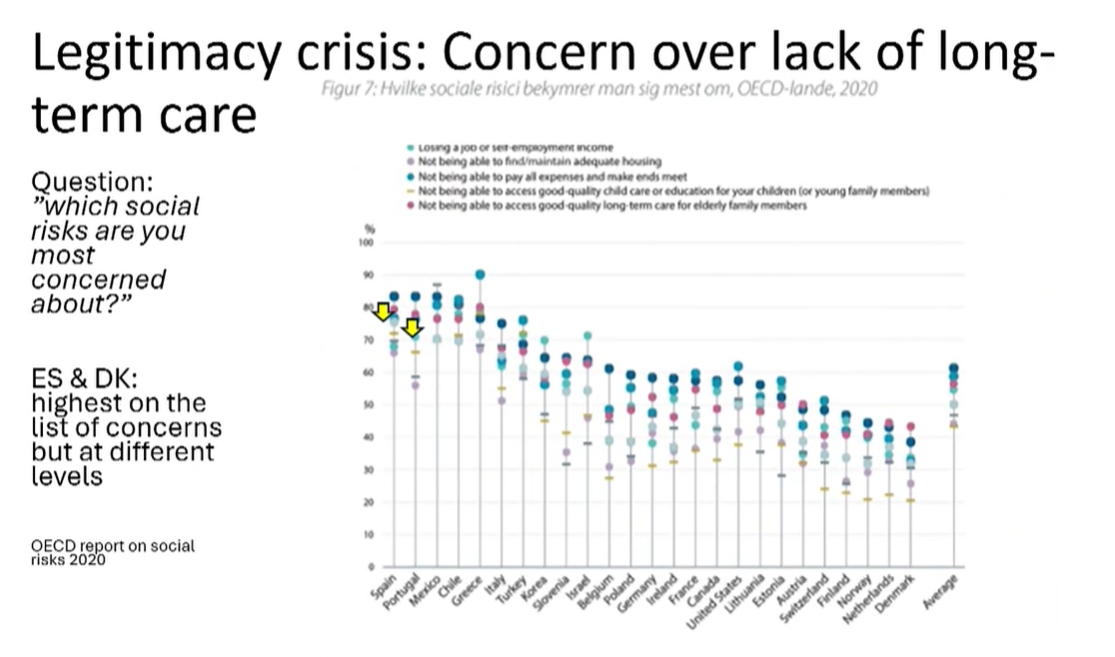
Rostgaard connected these developments to a broader crisis of care systems across Europe. Referring to an OECD survey on social risks (2020), she noted that concern about access to quality long-term care for older family members is widespread, particularly in countries like Spain and Portugal.
On the other hand, Nordic countries governments have attempted deregulation decentralizing duties to municipalities (models inspired by the Dutch Buurtzorg approach, based on small, self-managed teams, aim to improve job satisfaction and care quality). However, decentralisation also creates territorial inequalities because the experience of citizenship can differ significantly depending on where one lives. Another approach focuses on recognition without redistribution, such as symbolic appreciation or wage increases, but it does not address structural shortcomings.
In conclusion, care systems should be assessed by whether the reforms improve access equality, reduce the gendered burden on families, protect the dignity of care recipients, and fairly recognise and reward care workers.
If these conditions are not met, the system may appear legitimate for a while, but care crisis as a matter of social justice will persist.
. . .
This event is a joint initiative between Alkartasuna Fundazioa and Coppieters Foundation.
. . .
This event is financially supported by the European Parliament. The European Parliament is not liable for the content of the event nor for the opinions of the speakers.
. . .
Thank you for following our activities over the past few years. We hope our updates have been useful to you. We would like to keep informing you about upcoming events, new publications, summer schools, and job vacancies. Subscribe to our newsletter to hear from us in your inbox.