
Quick reference guide: The Right to Self-Determination at International Level
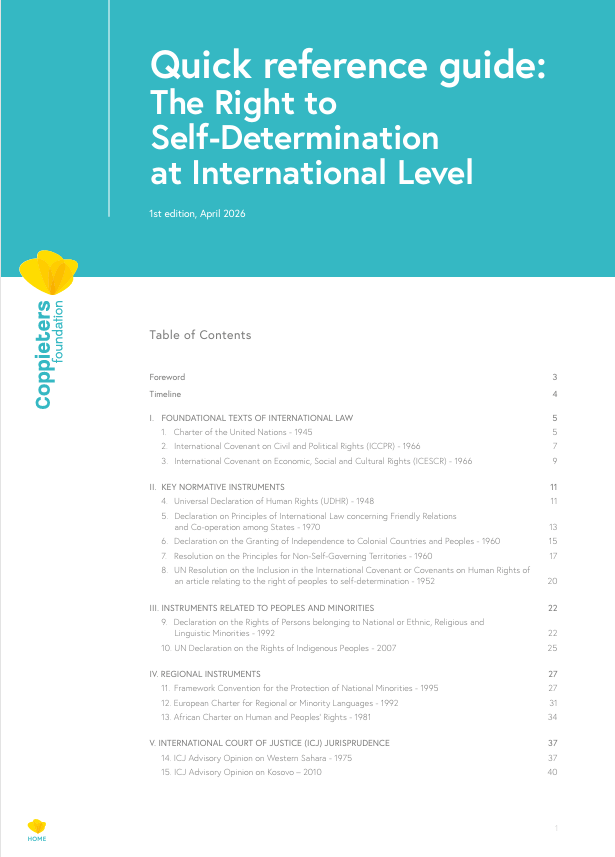
This quick reference guide is intended to help readers navigate debates around the right to self-determination and other adjacent topics like minority rights, cultural rights and indigenous rights.
It lists 20 of the main instruments (treaties, conventions, resolutions, opinions), that are referenced at international level when discussing the basis for the implementation of the right to self-determination: political participation and representation, peace promotion and the capacity for the peoples to freely determine their political status and freely pursue their economic, social and cultural development.
The reference guide is structured by the nature and salience of the instruments rather than chronologically. It covers foundational texts like:
• Foundational texts of international law
• Key Normative Instruments
• Instruments Related to Peoples and Minorities, including regional instruments
• International Court of Justice Jurisprudence
• Expert Interpretations and Committees
• Law of the Treaties and Succession of States
Each instrument follows the same structure: an analysis of the context and relevance of the instrument for self-determination, its reference in the UN and international legal system, its date of adoption or entry into force, a selection of relevant articles that can be reproduced verbatim in discussions, and links to accessible and where possible, certified digital copies.
This guide is to a certain extent the by-product of a long journey carried out at global level by Coppieters Foundation, most notable in connection to debates, workshops and events at UN committees and UN forums both in Geneva and New York. It aims to clarify an area of international law that is often misunderstood or mischaracterised, yet sits at the core of the global system of governance and has proven key to ensure long lasting peace and stability when proactively implemented.
. . .
This paper is an initiative of Coppieters Foundation.
. . .
This paper is financially supported by the European Parliament. The European Parliament is not liable for the content of the paper or the opinion of the author.
. . .
Thank you for following our activities over the past few years. We hope our updates have been useful to you. We would like to keep informing you about upcoming events, new publications, summer schools, and job vacancies. Subscribe to our newsletter to hear from us in your inbox.