
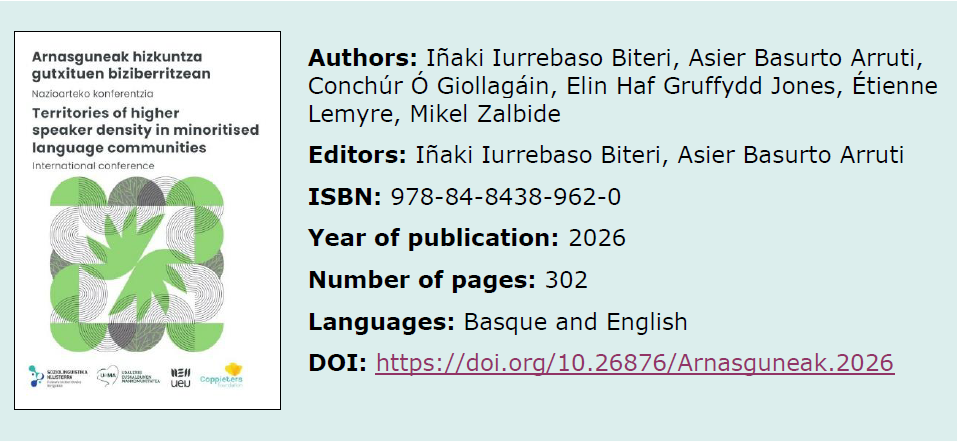
Arnasguneak hizkuntza gutxituen biziberritzean / Territories of Higher Speaker Density in Minoritised Language Communities has now been published
The volume draws on a selection of the presentations and reflections shared at the international conference held in Azpeitia (Basque Country) on 16 and 17 October 2025, and is available in both Basque and English.
The publication aims to organise and disseminate internationally the knowledge generated around the strategic role played by territories with a high density of speakers in the revitalisation of minoritised languages.
The conference was organised by UEMA, the Sociolinguistics Cluster, the UEU and the Coppieters Foundation. Its aim was to bring the research and reflection developed in the Basque Country on territories of higher speaker density into dialogue with other international approaches.
Researchers, practitioners and representatives of institutions from Ireland, Scotland, Wales, Canada, Catalonia, South Tyrol, Vojvodina and the Basque Country examined the current situation, functions and future challenges of territories with a high density of speakers.
The publication is not simply a transcript of the conference sessions. A number of the contributions presented at the event have been revised, expanded and structured in a scientific and academic format, making the ideas and discussions generated at the conference available to a wider scientific and social community. The volume was edited by Iñaki Iurrebaso Biteri and Asier Basurto Arruti, published by the UEU, and comprises 302 pages.
Six contributions exploring the importance of territories of higher speaker density from different perspectives
The book opens with a contribution by Mikel Zalbide. Zalbide explains the concept and defining features of arnasguneak, as well as their importance for the revitalisation of the Basque language. The text consists of selected passages from his article originally published in issue 110 of Bat Soziolinguistika Aldizkaria.
Arnasguneak are areas in which a minoritised language is socially predominant and where language use and intergenerational transmission take place more naturally than in other settings.
Conchúr Ó Giollagáin analyses the survival of vernacular communities of minoritised languages, placing social dynamics and ethnolinguistic vitality at the centre of his approach. Étienne Lemyre, meanwhile, uses data from Canada and Quebec to examine how the local density of French speakers affects language use, transmission and knowledge.
Elin Haf Gruffydd Jones explores the connections and codependence between communities with high, medium and low densities of Welsh speakers from the
perspectives of language policy and territorial planning. The article brings the situations in Wales and the Basque Country into dialogue and underlines the need to consider the relationships between areas with different speaker densities.
The collection is completed by two studies focusing on the Basque Country. Asier Basurto Arruti and Iñaki Iurrebaso Biteri examine how residential mobility and movement between territories with different sociolinguistic densities affect the use of Basque.
Iñaki Iurrebaso, for his part, analyses how the impact of the expansion of Basque-language competence varies according to the sociolinguistic characteristics of each territory and proposes the need for a territorial strategy for the revitalisation of Basque.
From theoretical knowledge to language-policy proposals
Although the contributions included in the publication draw on different perspectives and methodologies, they share a common premise: territories with a high density of speakers require priority attention in minoritised-language revitalisation processes. Ensuring the intergenerational continuity of the language community, its social development and the natural use of the language in these areas is essential.
At the same time, the publication shows that territories of higher speaker density cannot be understood as isolated areas. Mobility, relationships and mutual influence between areas with lower and higher concentrations of speakers shape the development of the language community as a whole. The protection and development of these territories must therefore form part of broader strategies connecting language policy with territorial planning, socioeconomic activity and social cohesion.
The book is intended for researchers, practitioners, institutional representatives and social actors working in the field of Basque-language revitalisation. It also aims to serve as a reference for international researchers by connecting research strands developed in different language communities on territories of higher speaker density, vernacular communities and speaker density.
The full publication and each of its six articles can be read and downloaded individually in Basque and English from the publication’s academic website, here: https://doi.org/10.26876/Arnasguneak.2026 . The volume as a whole has its own DOI identifier, as does each individual article.
. . .
Coppieters Foundation is financially supported by the European Parliament. The European Parliament is not liable for the content of the conferences, events or the opinions of the authors of our publications.
. . .
Thank you for following our activities over the past few years. We hope our updates have been useful to you. We would like to keep informing you about upcoming events, new publications, summer schools, and job vacancies. Subscribe to our newsletter to hear from us in your inbox.